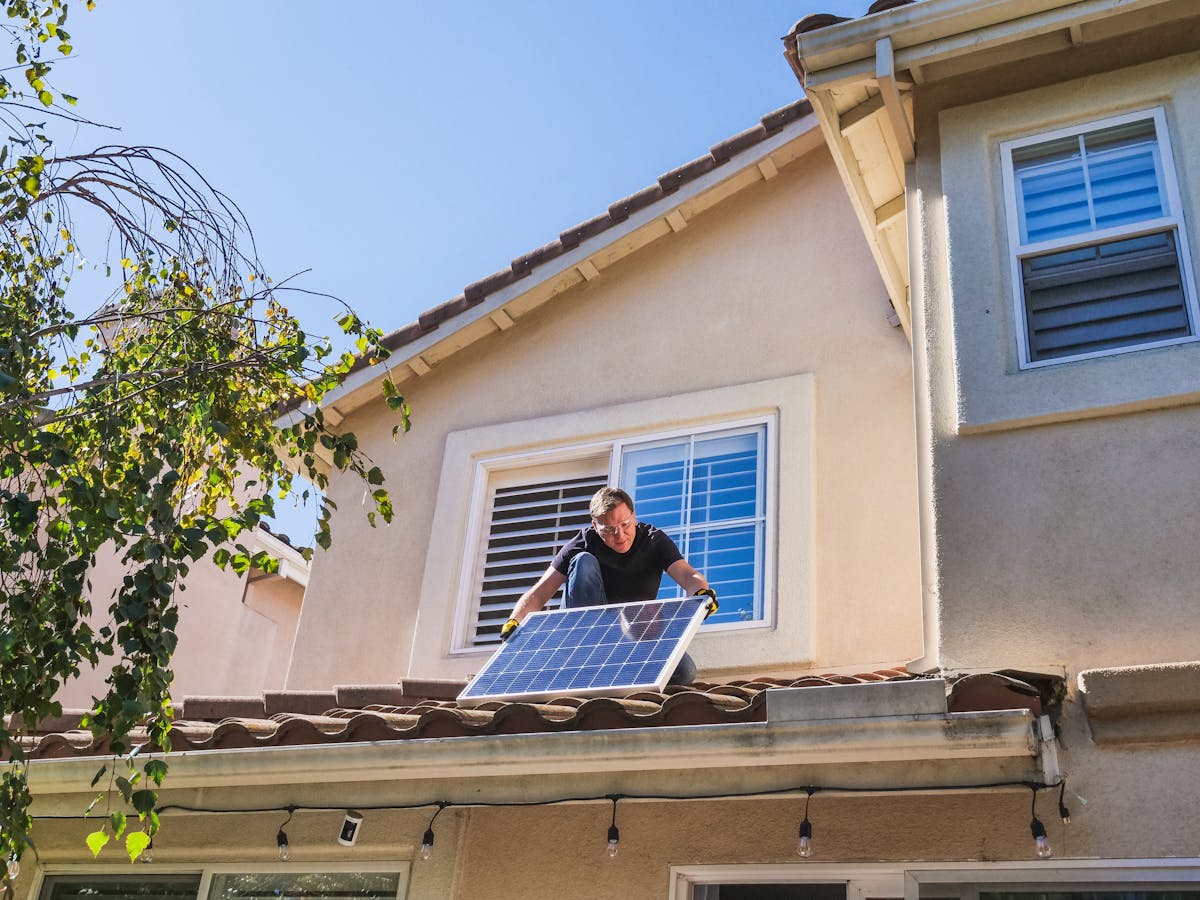
The most important solar PV decision on a UK new build is when to install — during construction or as a post-completion retrofit. The financial gap between the two is material (roughly 20-30% on a like-for-like system), but the more interesting differences are in integration, warranty and aesthetic outcomes.
Cost difference: new build wins by roughly 20-30%
A 4.0 kWp in-roof PV system installed during construction runs at about £1,200/kWp — roughly £4,800 (Spirit Energy publishes ~£1,200/kWp ex VAT and scaffolding for roof-integrated solar). The same capacity retrofitted on-roof to the completed dwelling costs £1,565–£1,686 per kWp on the MCS Installation Database 2026 average — £6,260–£6,740. The cost gap reflects: (1) labour — retrofit requires a separate scaffold mobilisation and additional plot access vs new-build factory pre-fit; (2) on-roof vs in-roof — retrofit invariably uses on-roof systems (in-roof retrofit requires stripping the existing roof, uneconomic); (3) design stage — in-roof panels displace tile cost when specced before the roof package is ordered.
Integration with ASHP, battery and MVHR
New-build installation lets the solar PV system integrate cleanly with the rest of the building services. Inverter and battery locations are planned into the M&E layout at RIBA Stage 3, with adequate clearance, ventilation and serviceability. ASHP and PV controls share a common BEMS where appropriate. MVHR ducting routes around inverter heat dissipation. Retrofit installations work around the existing layout — inverters end up in suboptimal locations (under stairs, behind boiler cupboards), service routing improvised, and post-install commissioning of the integrated control system can take days that would have been hours on a planned new build.
FHS compliance only works at new-build phase
The Future Homes Standard 40% PV requirement applies to new dwellings — there is no equivalent retrofit requirement. Building a new dwelling without FHS-spec PV is not legally compliant from 24 March 2027. Retrofitting to an FHS-non-compliant dwelling is voluntary. This is the underlying reason new-build installation is universal across volume housebuilder programmes from 2027.
Warranty and EPC outcomes differ
New-build installations are typically commissioned with an EPC band A or upper B rating because all building services are FHS-compliant. Retrofit PV onto a 2021-spec dwelling typically lifts EPC from band C/D to band B at best — the fabric and heating system limit the upside. NHBC, LABC, Premier and Buildmark warranties cover new-build PV through the structural warranty programme; retrofit PV requires separate installation warranty (typically 20 years insurance-backed) but doesn't adjust the dwelling's structural warranty terms.
Aesthetic and sales-value outcomes
New-build installations almost always specify in-roof PV — flush with the roof tile or slate line. Retrofit installations almost always specify on-roof — visibly mounted above the tile line on rails. Estate agent feedback from 2025 buyer panels: in-roof installations contribute meaningfully to sale price (4-6% premium on EPC A vs B); on-roof retrofit shows less impact (1-3% premium) because the visible panel array is perceived as added equipment rather than integrated design.
When retrofit is the right choice
Three scenarios where retrofit makes sense despite the cost premium: (1) homeowner buying an existing 2024-vintage non-PV dwelling and seeking to upgrade — retrofit is the only option; (2) developer with existing land bank of pre-FHS plots in build-out — completing to 2021 spec under the transitional period and retrofitting if and when buyer demand justifies; (3) housing association with stock acquired pre-FHS that needs energy upgrades for tenant fuel-poverty intervention — retrofit accelerates outcomes. Outside these cases, new-build phase installation is the clear preference.
The strategic lesson
For any UK new-build project commencing planning from 2026 forward, treat solar PV as an integral building service rather than an optional bolt-on. Engage the PV designer at RIBA Stage 2, lock per-plot pricing at land bid, specify in-roof systems with factory pre-fit on panelised roof cassettes where applicable. The 20-30% cost saving versus retrofit is meaningful, but the integration and warranty advantages are what make the choice obvious.