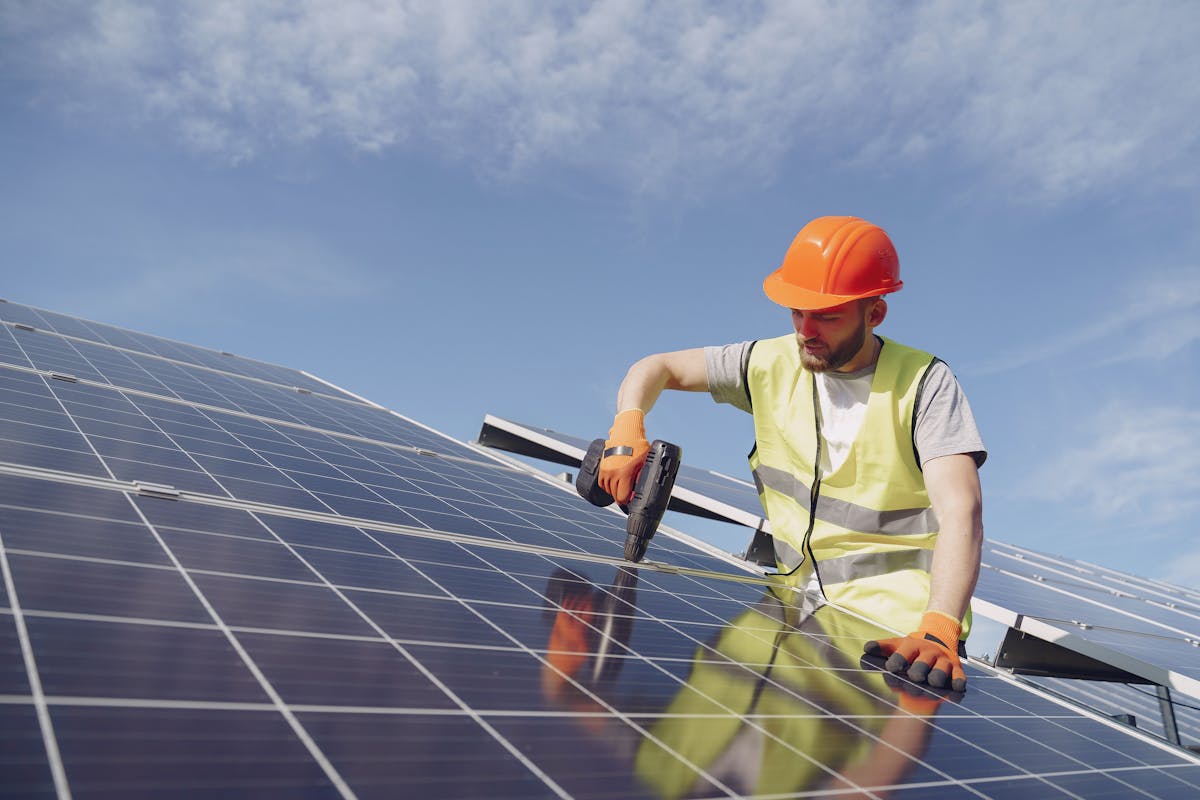
Solar PV and smart home integration in 2026 — UK new build solar PV installation
Smart home · 8 min read · 07 May 2026

Solar PV and smart home integration in 2026

How FHS-compliant solar PV integrates with smart-home systems — Loxone, Hubitat, Home Assistant — and what API access from inverter manufacturers makes possible in 2026.

Solar PV has been "smart" for a decade — inverters communicate with monitoring apps, batteries optimise charging based on tariff signals, and EV chargers divert surplus PV to vehicles. In 2026 the integration has reached a new level: open API access from the major inverter manufacturers makes solar PV a first-class citizen in any home-automation system. This article covers what's possible, what manufacturers support, and how to specify it on a new build.

What "smart" means in 2026 solar

Three layers of integration matter: (1) Monitoring — real-time visibility of generation, consumption and export; this has been mainstream since 2018. (2) Optimisation — automated charging of batteries during off-peak tariff windows and discharging during peak periods; mainstream since 2022. (3) Whole-home automation — solar generation triggering decisions across heating, EV charging, hot water and discretionary loads (dishwashers, washing machines, pool heaters); this is the 2025-26 capability that's newly mainstream.

Inverter API support

The four most-installed inverter brands in UK new builds all support open APIs in 2026: SolarEdge (REST API via solaredge.com), SunSynk (MQTT and REST), Enphase (Enlighten API), and GivEnergy (REST and MQTT). All four return real-time generation, consumption, battery state-of-charge and grid import/export data. The APIs are documented, free for owner use, and rate-limited at generous levels (typically 60+ requests/hour).

Home automation platforms

Three platforms dominate UK self-build home automation: (1) Loxone — a Linz-based system with strong UK installer network, native Modbus and MQTT support, used on many architect-led custom builds; (2) Home Assistant — open-source, runs on a Raspberry Pi or NUC, has community integrations for every major UK inverter brand; (3) Hubitat — local-first hub-based system, growing UK presence, native Z-Wave/Zigbee plus REST integrations. All three integrate with the major inverter APIs through standard plugins or with light bridging code.

Practical automations on a new build

Common automations we see specified on self-build FHS installations: (1) EV solar diversion — Zappi charger reads inverter generation and diverts surplus PV to the car, no grid import; (2) Battery tariff optimisation — battery charges from grid during 30p Octopus Agile cheap-rate windows, discharges during 70p+ peaks; (3) Hot water heat-up — immersion heater triggered when battery is full and surplus PV is being exported, providing free hot water; (4) Dishwasher / washing machine deferral — appliances wait for surplus PV (Miele and Bosch both support this through their respective APIs); (5) Pre-heating — ASHP runs at higher setpoint when PV is generating, banking heat for the evening.

What new-build wiring should include

For maximum smart-home flexibility post-completion, the new-build first-fix wiring should include: (1) Cat6 ethernet to the inverter location (not just WiFi — for API reliability); (2) Modbus RS485 cable run from inverter to the home-automation hub location; (3) Spare 16A circuit for a controllable immersion heater; (4) Smart-meter compatibility (most UK new-build smart meters now support consumer access devices for direct half-hourly data access); (5) Ethernet runs to plant room equipment (ASHP, MVHR) where the manufacturers support BMS-level integration. None of these adds material cost on a new build if planned at first-fix — all are expensive retrofits.

Privacy and data ownership

A real consideration in 2026: inverter manufacturer cloud APIs require account registration and stream usage data to the manufacturer. For homeowners who care about data sovereignty, local-only solutions (Modbus to Home Assistant) exist for all major brands. For others, the cloud APIs are convenient and well-supported. Either route is compatible with FHS compliance — there's no regulatory requirement on data architecture.

The next frontier — V2X

Vehicle-to-Home (V2H) and Vehicle-to-Grid (V2G) are mostly still 2027-28 capability for UK new builds. The hardware is here (Nissan Leaf, Kia, BYD all support V2X; Wallbox and EVTec are shipping bidirectional chargers), but DNO approval and tariff support are not yet at scale. New-build wiring should be specified to support 7 kW bidirectional EV charging — a 32A circuit to the EV charger location with provision for an isolator switch is the practical detail.

40% of ground floor area
PV / ground floor area
Mar 2027
FHS in force
75%
CO₂ vs 2013 baseline
£4,350 per dwelling
Per-plot premium
For developers and housebuilders

Solar pv and smart home integration in 2026 for volume new-build programmes

Per-plot pricing locked at procurement. Factory pre-fit on panelised roof cassettes. SAP/HEM modelling for every house type included. NHBC, LABC, Premier and Buildmark warranty-accepted workmanship. 20-year insurance-backed system warranty. We work with developers from 50 plots to 5,000+ across multi-site frameworks — agreed pricing, agreed programme, agreed warranty stack.

For self-builders and architects

Solar pv and smart home integration in 2026 for one-off custom builds

Engagement from RIBA Stage 2. PV sizing collaborative with the architect. SAP/HEM modelling that gives the architect freedom on glazing ratios and roof geometry. Building Control submission pack ready for the Approved Inspector. 0% VAT on new-build dwellings. Staged invoicing aligned to your self-build mortgage drawdowns. We work with custom-build buyers across England, Wales and Scotland.

How this fits into the FHS compliance pathway

Every FHS-compliant new build must pass three regulatory gates. Solar pv and smart home integration in 2026 fits primarily into the second gate — design-stage Part L compliance — but has knock-on implications for Building Control sign-off and post-completion warranty:

  1. 1
    Planning permission Most solar PV on new dwellings is consented within the dwelling\'s primary planning consent. Conservation Areas, Article 4 directions and listed-curtilage plots require additional planning consideration — we handle the planning evidence required for these.
  2. 2
    Building Control — Part L compliance SAP 10.3 or HEM compliance modelling demonstrating Dwelling Emission Rate ≤ Target Emission Rate. PV specification, ASHP capacity, fabric U-values and air permeability all entered into the modelling. We provide the full compliance file ready for the Approved Inspector.
  3. 3
    Post-completion — warranty & EPC MCS certificate, EPC, monitoring app onboarding and 20-year insurance-backed workmanship warranty. NHBC, LABC, Premier and Buildmark all accept our installation specification without query — important if you\'re relying on a structural warranty for buyer mortgageability.

For a fuller walkthrough of the compliance process, see our Part L 2026 page and the FHS PV calculator which sizes a compliant system from your ground floor area in 30 seconds.

Frequently asked

Common questions

Answers to the questions we get most often when discussing solar pv and smart home integration in 2026 with new clients.

When does the Future Homes Standard come into force?
24 March 2027 in England, with a 12-month transitional period running to 24 March 2028 for projects already under construction. The Approved Documents L and F were published on 24 March 2026 (Government statement HCWS1445), giving the industry exactly 12 months of certainty before regulatory commencement. Scotland, Wales and Northern Ireland are following with broadly equivalent regulations on roughly aligned timetables, although devolved nuances apply — Welsh regulations are typically 6 months ahead.
What does FHS-compliant solar PV actually cost per plot?
The Government Impact Assessment puts the total FHS premium at ~£4,350 per dwelling per dwelling (2025 prices, weighted average across heat pump, solar PV, MVHR and enhanced fabric). Of that, solar PV is roughly £4,200 — covering ~3.4 kWp for a typical 3-bed semi (panels, in-roof mounting, inverter, monitoring, MCS certification and 20-year insurance-backed warranty). Larger dwellings cost proportionately more; volume procurement reduces per-plot cost by 20–25%.
Will the 40% PV rule actually be enforced?
Yes — the rule is a functional requirement in the Approved Document, not guidance. Building Control sign-off requires SAP/HEM modelling demonstrating compliance. The previous Part L 2021 token "2-panel" systems no longer pass, since they fall ~85% below the 40% benchmark. The deemed-to-satisfy route requires the full 40%; alternative compliance through enhanced fabric is possible but rarely cost-effective.
Can I exceed FHS minimum specifications?
Yes — and many self-builders and premium developers do. Marginal capital cost of a larger array (e.g. 5 kWp instead of 3.4 kWp on a 3-bed) is only £1,000–£1,200, while the additional generation pays back in 3–4 years at 2026 electricity tariffs. Upgrades that fit easily on top of an FHS-compliant base include battery storage (£3,500–£5,000), larger array size, EV charge point pre-fit (£600) and air permeability below 2 (achievable with deliberate detail).
FHS 2027 deadline approaching

Get an FHS-compliant solar quote in 48 hours

Tell us your plot details — ground floor area, location and target start-on-site date. We return a fully-costed system sized to Part L 2026 (40% PV rule), with the SAP/HEM compliance pack included.