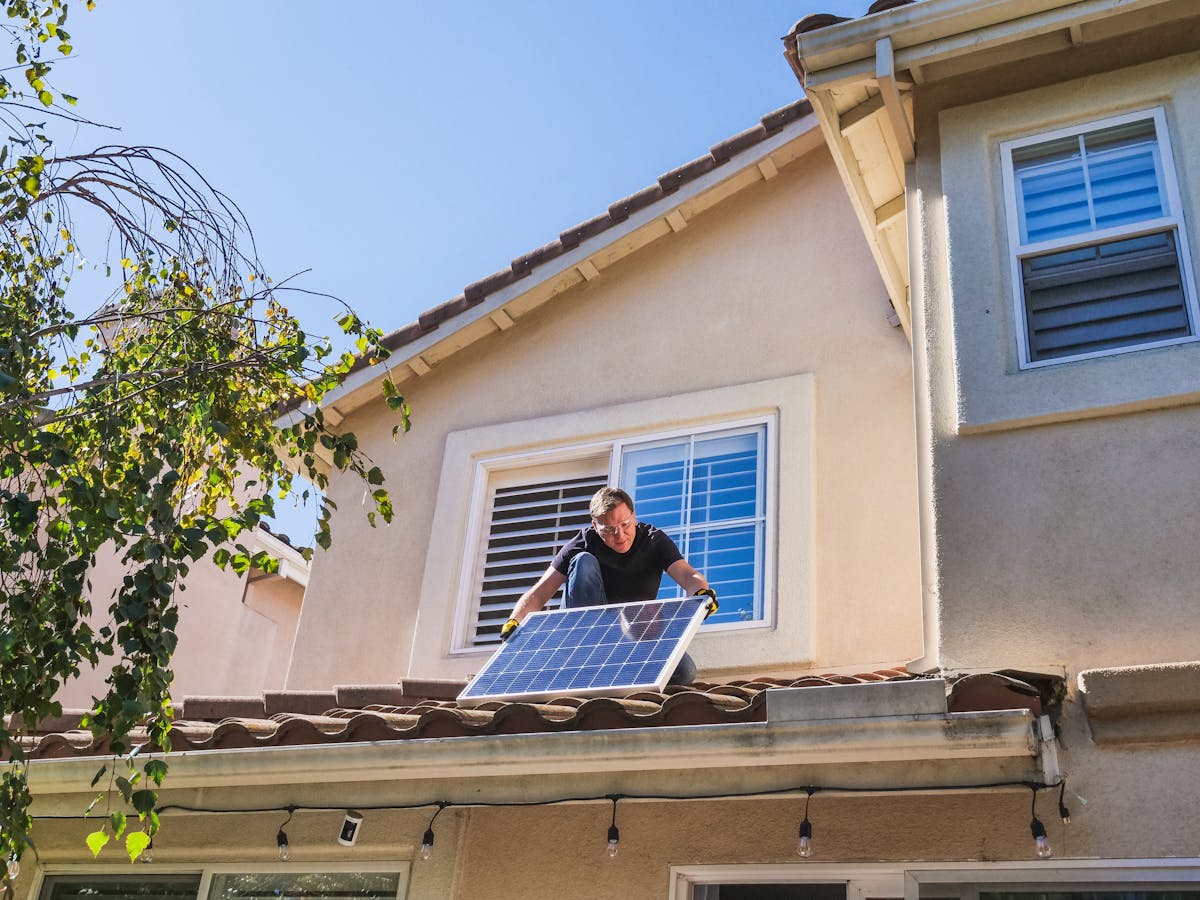
Solar panels building regulations questions have a short answer: on an existing home, building regulations will normally apply to rooftop solar, covering the roof's strength and the electrical work, and an installer registered with a competent person scheme can self-certify it. On a new build, the PV is part of the house's own building control approval, and from 24 March 2027 Part L 2026 expects it.
Do solar panels need building regulations approval?
For panels on an existing roof, usually yes. The Planning Portal's guidance for England, repeated word for word on the Welsh Government's site, says that if you install solar panels on your roof, building regulations will normally apply. It picks out two things: the ability of the existing roof to carry the load of the panels "will need to be checked and proven", and building regulations "also apply to other aspects of the work such as electrical installation".
That does not mean you have to apply to building control yourself. Most domestic solar is installed by firms registered with a competent person scheme, who can certify their own work as compliant. If you use an installer who is not registered, you or they will need to apply for approval before the work starts.
Which parts of the building regulations apply to solar panels?
Several parts of Schedule 1 to the Building Regulations can be engaged by a solar installation. The main ones are:
| Part | Covers | What it means for solar |
|---|---|---|
| Part A | Structure | The roof must carry the extra load. For an existing roof, the Planning Portal says its capacity must be checked and proven, and strengthening may be needed. For a new build, the array is included in the roof design. |
| Part B | Fire safety | Where a system replaces part of the roof covering, its fire performance matters. Roof-integrated mounting kits are tested and declared under MCS 012, so check the declared rating suits the building. |
| Part C | Resistance to moisture | Fixings, flashings and in-roof trays must keep the weather out. MCS 012 includes wind-uplift and rain-penetration tests for mounting kits. |
| Part P | Electrical safety (dwellings) | The electrical installation must be safe and is usually notifiable. A registered electrical installer can self-certify it and issue the certificate. |
| Part L | Energy and greenhouse gas emissions | Requirement L2 expects generation systems to be sized for the site, commissioned to the manufacturer’s instructions and controllable without user intervention. Requirement L3 expects new homes to have on-site renewable generation. |
On a new build, all of these are handled within the building control approval for the whole house. On an existing home, the structural check and the electrical work are the parts most likely to need attention.
Competent person schemes: how self-certification works
A competent person scheme lets a registered installer self-certify certain types of building work. GOV.UK's list of authorised schemes (updated 17 September 2026) includes solar photovoltaic installation under "microgeneration and renewable technologies", with schemes run by APHC, BESCA, Certsure, HETAS, NAPIT and OFTEC. Electrical work in dwellings has its own category, covering fixed low or extra-low voltage electrical installations.
GOV.UK describes what you get when you use one. The installer will tell your local authority about the work on your behalf if needed, and will give you a certificate within 8 weeks of completion that can be used as evidence of compliance. The scheme works instead of you applying for building regulations approval, so there is no separate application or fee from you.
Before you sign, ask the installer which scheme they belong to and check the registration. Keep the compliance certificate with your property documents: a buyer's solicitor may ask for it when you sell.
New builds: how solar fits the building regulations
On a new home, solar PV is not a separate job with its own approval. It sits inside the building control approval for the house, whether through a full plans application, a building notice or, with a registered building control approver, an initial notice. The energy calculation for the house includes the array, and building control reviews it with everything else.
From 24 March 2027, Part L 2026 adds requirement L3: on-site renewable electricity generation for new dwellings in England. Approved Document L paragraph 5.73 sets the benchmark as an annual output at least equal to a reference array of 0.22 kWp/m² over 40% of the house's ground floor area, or an array covering the reasonably practicable roof area. For a house with a 42.5 m² ground floor, that reference works out at 3.74 kWp. The Part L 2026 guide explains the rule and the transitional dates in full, and the 40% PV rule explainer covers sizing on awkward roofs.
Planning permission is a separate question
Building regulations and planning permission are two different consents. For an existing house, the Planning Portal says solar panels and equipment on residential buildings "may be 'permitted development'" with no need to apply for planning permission, provided important limits and conditions are met. Listed buildings, conservation areas and Article 4 directions can change that, so check before you commit.
For a new build, the roof and any PV are part of the planning application for the house itself. See the guide to planning and solar in conservation areas for the heritage cases.
Connecting to the grid: G98 and G99
Every grid-connected system has to be notified to the local network operator. A system up to 16 A per phase, which is 3.68 kW on a single-phase supply, is installed and then notified under G98 after commissioning. A larger system, or one that exceeds that limit, needs approval under G99 before it is connected. On a new-build estate, the developer usually raises capacity with the network operator early, because many homes connecting at once can matter for the local network.
MCS certification and the Smart Export Guarantee
MCS certification is not a building regulation, but it is the standard most homeowners need. The MCS installation standard for solar PV is MIS 3002, and roof mounting kits are covered by MCS 012, which tests resistance to wind loading, reaction to fire and resistance to water penetration. The MCS certificate issued at handover is what an energy supplier asks for before paying for exported electricity under the Smart Export Guarantee.
Checklist: the paperwork you should end up with
- The installer's competent person scheme registration, checked before you sign.
- The building regulations compliance certificate, within 8 weeks of completion.
- Confirmation that the roof's capacity was checked, and details of any strengthening.
- The electrical installation certificate for the new circuit.
- The MCS certificate, and the product and mounting-kit details.
- Proof of the G98 notification, or the G99 approval for a larger system.
- The manufacturers' warranties for panels and inverter, and the installer's workmanship warranty.
For a new build, the same documents belong in the homeowner handover pack alongside the building control completion certificate and the EPC. For the tax side, including why solar fitted during construction carries no VAT, see VAT on solar panels.
Wales and Scotland
The Welsh Government's guidance on solar panels and building regulations uses the same wording as England's: building regulations will normally apply, and the roof's capacity must be checked and proven. Wales has also published its own Approved Document L (2026) for new homes. Scotland runs a separate building standards system, so check with the local authority's building standards service before starting work there.