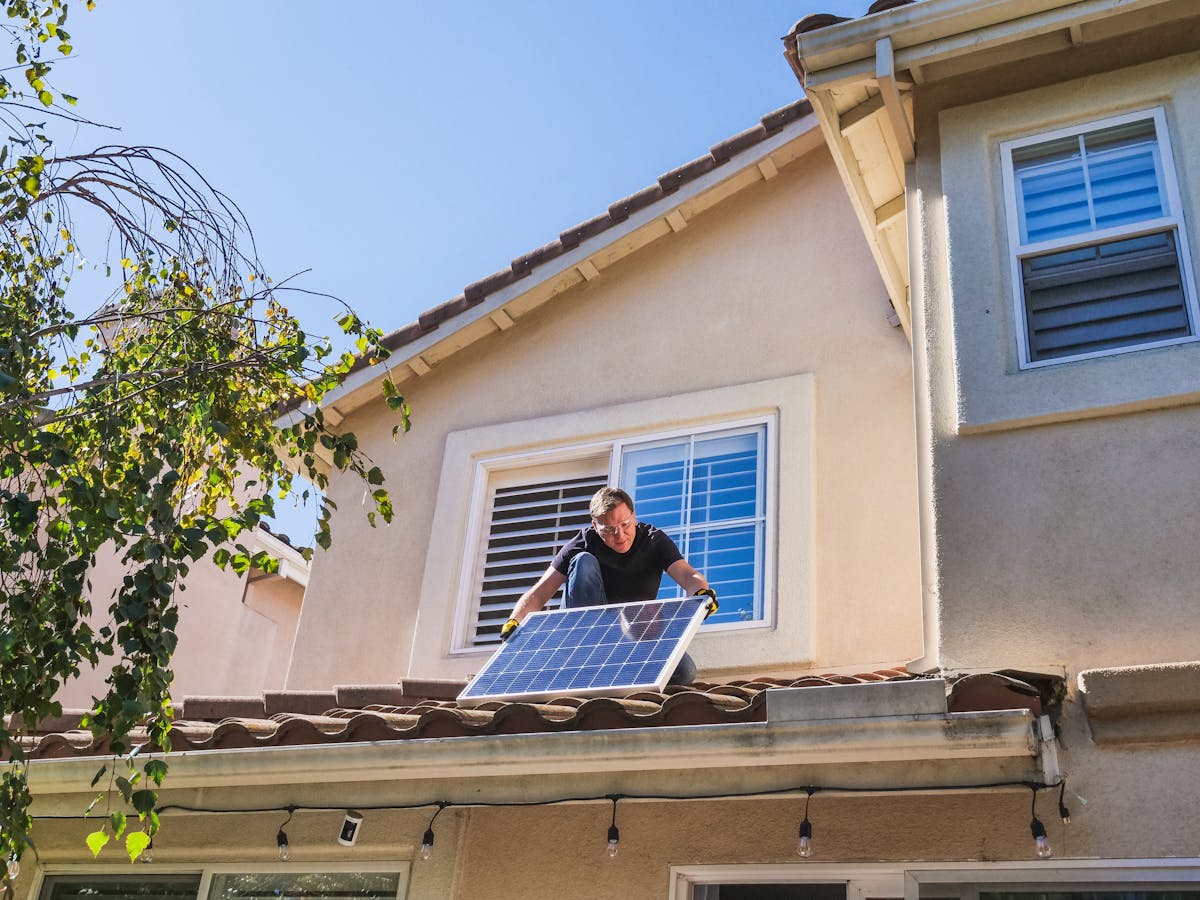
Lightweight solar for modular buildings spans ~1.8–4 kg/m² (flexible thin-film/CIGS) up to 12–15 kg/m² (standard in-roof) — versus 15–25 kg/m² for rail-mounted on-roof systems. Most Category 1 and 2 MMC housing roofs take standard in-roof PV; membrane-bonded thin-film solves the genuinely weight-constrained flat-roof module.
Why MMC and solar fit together
This page is about homes built by modern methods of construction — volumetric modular housing, panelised timber-frame and light-gauge steel systems, and the build-to-rent, student and council-led schemes they serve. Modern Methods of Construction share a defining characteristic: the building is substantially assembled in a factory before it reaches the site. That changes the economics of solar PV in three ways:
- 1Factory pre-fit. In-roof solar cassettes are installed on the roof module at the factory, weatherproofing tested under cover, and craned into place as part of the module. On-site labour drops from ~10 hours (site-built on-roof) to ~2 hours per plot.
- 2Air permeability advantage. Factory-built modules test at 1.5-2.5 m³/(h·m²), beating the FHS 3 target without the deliberate on-site sealing that site-built homes require.
- 3Service integration. MVHR ducting, inverter location and battery provision are all designed into the module rather than improvised on site — cleaner, faster, more reliable.
Lightweight solar panel options compared
Most MMC roof structures carry a standard in-roof PV system without difficulty. Where roof loading is constrained — light-gauge steel modules, membrane flat roofs, or modules with long unsupported spans — these are the lightweight options, compared like-for-like:
| Technology (example product) | Weight | Form | Best MMC fit |
|---|---|---|---|
| Flexible thin-film CIGS (e.g. Axter Solar PV Flex — CIGS bonded into reinforced-bitumen membrane) | ~2.2–2.9 kg/m² (Axter module 2.9 kg/m²) | peel/bond, flexible | flat-roof volumetric modules; membrane roofs |
| Solivus thin-film (~4 mm fibreglass carrier board, 1×2 m) | ~1.8–4.0 kg/m² | bonded board/film | weight-constrained commercial-scale roofs |
| Glass-free composite crystalline (Sunman eArc SMF430F, glass-fibre-reinforced polymer) | 430 W at 11.2 kg per panel; ~70% lighter than glass modules | rigid ultra-thin panel | light-gauge steel module roofs |
| Standard in-roof crystalline | 12–15 kg/m² | roof-integrated cassette | default for Cat 1/2 pitched MMC roofs |
| Rail-mounted on-roof | 15–25 kg/m² | clamped above covering | traditional roofs; avoid on constrained modules |
The trade-off is real: lightweight films deliver a lower W/m² than crystalline glass and carry different warranty and fire-classification profiles — spec them only when roof loading genuinely demands it, not as a default. For how the two standard mounting routes compare on a conventional pitched roof, see in-roof vs on-roof weight and cost compared.
One clarification worth making: the Solivus Arc is a ground-mounted unit — 2 m in diameter and 1.4 m high, pre-production, generating around 1,000 kWh per year — not a roof panel. The roof products above are the relevant comparison for a modular building.
Roof loading for MMC solar: the numbers
Structural engineers work in kilonewtons per square metre: 1 kN/m² ≈ 102 kg/m². A rail-mounted PV system adds a dead load of roughly 0.15–0.25 kN/m²; the lightweight systems above add a fraction of that:
| System | Dead load (kg/m²) | Dead load (kN/m²) |
|---|---|---|
| Flexible thin-film / membrane-bonded CIGS | ~1.8–4 kg/m² | ~0.02–0.04 kN/m² |
| Standard in-roof crystalline | 12–15 kg/m² | ~0.12–0.15 kN/m² |
| Rail-mounted on-roof | 15–25 kg/m² | ~0.15–0.25 kN/m² |
| Ballasted flat-roof system | 30–60 kg/m² | ~0.29–0.59 kN/m² |
The design context those numbers sit in: the UK National Annex to BS EN 1991-1-1, Table NA.7, sets an imposed load of 0.6 kN/m² for category H roofs (accessible only for maintenance) at slopes below 30°, and SCI Advisory Desk note AD 541 permits 0.4 kN/m² where PV panels occupy the roof area. Snow loads (BS EN 1991-1-3) and wind uplift (BS EN 1991-1-4) must be combined with the dead load — uplift, not weight, often governs on lightweight roofs. Light-gauge steel and timber-cassette MMC roofs vary widely in capacity, so the module manufacturer’s structural engineer signs off the chosen PV system against these load combinations for each module type; that sign-off is part of our design stage, not an afterthought.
Once the roof can take it, the question becomes how much array each plot needs — size your array with the new-build solar calculator.
Which MMC category are you building?
The MHCLG MMC Definition Framework (2019) splits modern methods of construction into seven categories, and the right solar route follows the category:
- •Category 1 — pre-manufactured 3D primary structural systems (volumetric). Factory pre-fit: the in-roof cassette or membrane-bonded film goes onto the roof module before it is craned into position.
- •Category 2 — pre-manufactured 2D panelised systems (timber frame, light-gauge steel, SIPs). Roof cassettes can be pre-fitted at the panel factory, or the in-roof system goes on at first fix once the roof is assembled on site.
- •Category 5 — pre-manufactured non-structural assemblies. Pre-wired service pods and inverter assemblies, delivered to site ready to connect.
Categories 3–7 also exist within the framework; they rarely change the solar specification. For how the categories interact with Future Homes Standard compliance, read the MMC and FHS solar guide.
The factory pre-fit programme
Our modular solar programme follows four stages, integrated with the manufacturer's production line:
| Stage | Where | What happens |
|---|---|---|
| 1. Design | Pre-production | Array sizing per module type, SAP/HEM modelling, cassette spec, structural sign-off |
| 2. Factory fit | Module factory | In-roof cassette or bonded film installed on roof module, weatherproofing tested |
| 3. Site install | On site | Module craned in, 2-hour final electrical connection per plot |
| 4. Commission | On site | MCS certification, monitoring onboarding, warranty handover |
What lightweight solar costs — and why it prices differently
Almost nobody publishing on lightweight modular solar puts numbers on it, so here is the honest framing. The baseline is conventional roof-integrated PV at roughly £1,200/kWp fitted at build stage (Spirit Energy's published basis, ex VAT and scaffold) against £1,565–£1,686/kWp for a standard retrofit on the MCS Installation Database 2026 average. Lightweight systems then move off that baseline through four drivers rather than a single headline rate:
- Watts per square metre. Thin-film and membrane-bonded products deliver less power per m² than crystalline glass, so a weight-constrained roof needs more area — or accepts a smaller array — for the same kWp.
- Fixing method. Membrane bonding and adhesive rails replace penetrative fixings and ballast; the labour profile shifts from roofing crew to manufacturer-approved installers, and warranties are conditional on the approved method.
- Structural sign-off. Light-gauge steel and timber-cassette MMC roofs need the module manufacturer's loading sign-off against wind uplift and snow combinations (BS EN 1991-1-4 / 1991-1-3) — a design cost conventional roofs rarely carry.
- Factory pre-fit offset. Fitting in the factory removes site scaffold and repeat mobilisation — the same driver that makes build-stage in-roof ~20–30% cheaper than retrofit applies to volumetric modules pre-fitted before craning.
Because product mix dominates the price, quotes are system-specific: compare them against the conventional baseline above and ask each bidder to state W/m², fixing method and who carries the structural sign-off. Size the array first with our new-build solar cost calculator.
Funding routes for MMC and modular solar
None of the top-ranking pages on this subject mention funding at all, yet it is usually the deciding factor. For residential MMC schemes the Future Homes Standard makes PV part of Building Regulations compliance from 24 March 2027 — the cost sits inside the build budget, offset by 0% VAT on new dwellings (Notice 708) and the FHS Impact Assessment's per-dwelling allowances. Developers model the per-plot economics with our ROI calculator and the bulk procurement guide; self-builders keep the 0% VAT relief and the finance routes on our funding page. Commercial modular estates (site offices, education blocks) sit outside FHS but inside standard capital allowances — solar is special-rate plant, claimed through the AIA rather than full expensing.
Lightweight solar for modular buildings in London
London's modular pipeline is dominated by build-to-rent towers, purpose-built student accommodation and council-led volumetric housing programmes. Those schemes typically sit on light-gauge steel modules with flat or membrane roofs — exactly the conditions where membrane-bonded CIGS or glass-free composite panels earn their place over standard glass modules. For a worked example of solar on a London BTR scheme, see the London build-to-rent solar case study.
Beyond London we cover the modular corridors where UK volumetric housing is actually manufactured and craned: Milton Keynes and the Ox-Cam arc, the East Midlands factory belt, and Yorkshire — see Milton Keynes, Yorkshire and the full coverage map.
We supply both standard and lightweight in-roof systems to the module assembly line — factory pre-fit where the programme allows, first-fix on site where it doesn't.
For the full case for MMC under the Future Homes Standard, read our timber frame and FHS pathway article. For the volume-developer procurement model, see bulk procurement pricing.
To discuss lightweight or factory pre-fit solar for your modular or MMC programme, request a consultation.