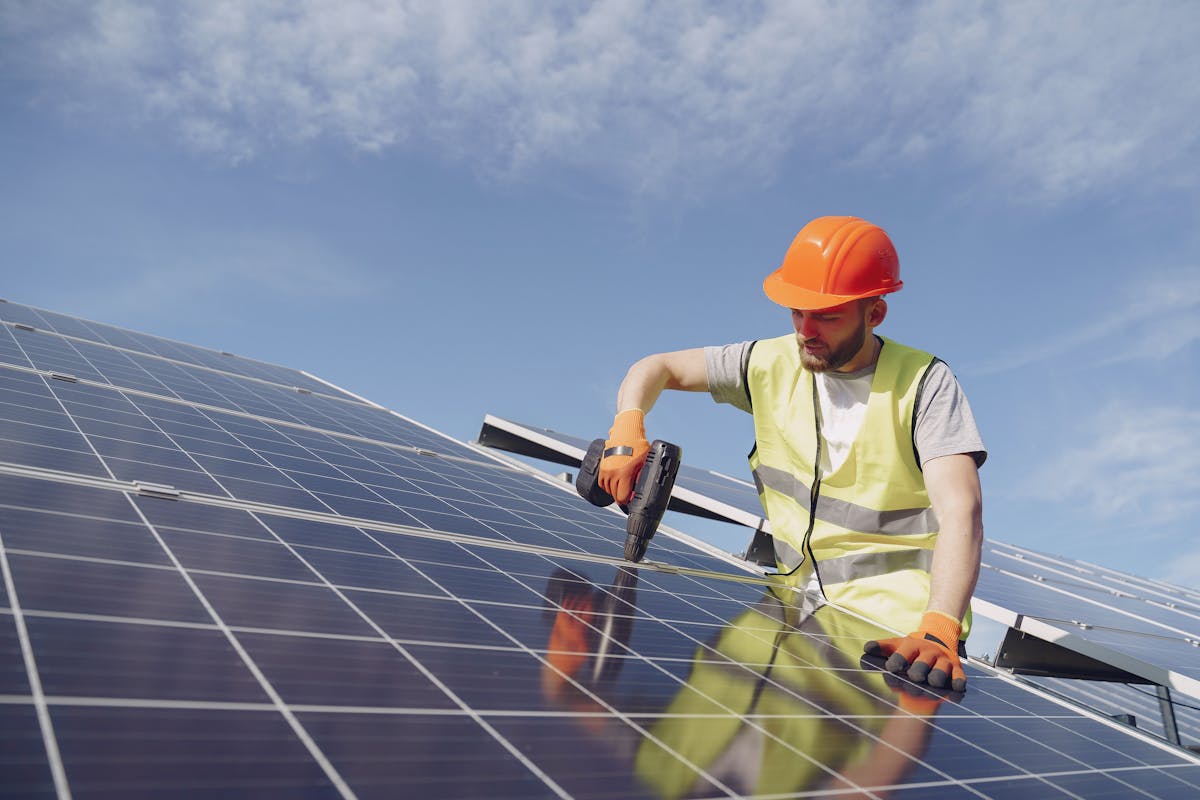
Who Owns the Solar Panels (and SEG) on a New Build? — UK new build solar PV installation
Finance · 5 min read · 23 Jun 2026

Who Owns the Solar Panels (and SEG) on a New Build?

On a UK new build, who owns the solar panels and gets the Smart Export Guarantee payments — you or the developer? The ownership question buyers must ask.

When you buy a new-build home with solar panels, you almost always own them outright as part of the property — this is the standard model used by Bellway, Persimmon, Taylor Wimpey and nearly every volume housebuilder. But ownership of the panels and the right to the export payments are two different things, and the second one trips up a surprising number of new-build buyers.

Do you own the solar panels on a new build?

In the overwhelming majority of private-sale new builds, yes. The panels are part of the building fabric, conveyed to you with the freehold or leasehold like the roof itself. A small number of social-housing and Build-to-Rent schemes use a third-party PPA (Power Purchase Agreement) model where an operator owns the array and sells you the electricity — but for a private-sale new build you own the system.

Who gets the Smart Export Guarantee (SEG) payments?

This is the question to nail before completion. The SEG pays you for surplus electricity exported to the grid (typically 4-15p/kWh). To claim it you need the system registered to you with a valid MCS certificate in your name and an export meter. The trap: some developer installs are registered to the developer or left unregistered, which can block or delay the buyer's SEG claim. Our new-build solar incentives guide explains the MCS-SEG link in detail.

What to confirm with your housebuilder

Before exchange, get written confirmation of four things: (1) you own the PV system outright; (2) the MCS certificate will be issued in your name at handover; (3) you receive the SEG export payments; and (4) the panel and inverter warranties transfer to you. These cost the developer nothing to confirm but materially affect the value you get from the system over 25 years.

Does owning the panels add value when you sell?

Yes — owned solar (versus a PPA-encumbered system) is cleaner at resale and contributes to the EPC A/B rating that FHS-compliant new builds achieve, which increasingly unlocks green-mortgage products for your buyer. A PPA arrangement, by contrast, transfers with conditions and can complicate conveyancing. For the full financial picture see our new-build solar finance guide and ROI calculator.

40% of ground floor area
PV / ground floor area
Mar 2027
FHS in force
75%
CO₂ vs 2013 baseline
£4,350 per dwelling
Per-plot premium
For developers and housebuilders

Who owns the solar panels (and seg) on a new build? for volume new-build programmes

Per-plot pricing locked at procurement. Factory pre-fit on panelised roof cassettes. SAP/HEM modelling for every house type included. NHBC, LABC, Premier and Buildmark warranty-accepted workmanship. 20-year insurance-backed system warranty. We work with developers from 50 plots to 5,000+ across multi-site frameworks — agreed pricing, agreed programme, agreed warranty stack.

For self-builders and architects

Who owns the solar panels (and seg) on a new build? for one-off custom builds

Engagement from RIBA Stage 2. PV sizing collaborative with the architect. SAP/HEM modelling that gives the architect freedom on glazing ratios and roof geometry. Building Control submission pack ready for the Approved Inspector. 0% VAT on new-build dwellings. Staged invoicing aligned to your self-build mortgage drawdowns. We work with custom-build buyers across England, Wales and Scotland.

How this fits into the FHS compliance pathway

Every FHS-compliant new build must pass three regulatory gates. Who owns the solar panels (and seg) on a new build? fits primarily into the second gate — design-stage Part L compliance — but has knock-on implications for Building Control sign-off and post-completion warranty:

  1. 1
    Planning permission Most solar PV on new dwellings is consented within the dwelling\'s primary planning consent. Conservation Areas, Article 4 directions and listed-curtilage plots require additional planning consideration — we handle the planning evidence required for these.
  2. 2
    Building Control — Part L compliance SAP 10.3 or HEM compliance modelling demonstrating Dwelling Emission Rate ≤ Target Emission Rate. PV specification, ASHP capacity, fabric U-values and air permeability all entered into the modelling. We provide the full compliance file ready for the Approved Inspector.
  3. 3
    Post-completion — warranty & EPC MCS certificate, EPC, monitoring app onboarding and 20-year insurance-backed workmanship warranty. NHBC, LABC, Premier and Buildmark all accept our installation specification without query — important if you\'re relying on a structural warranty for buyer mortgageability.

For a fuller walkthrough of the compliance process, see our Part L 2026 page and the FHS PV calculator which sizes a compliant system from your ground floor area in 30 seconds.

Frequently asked

Common questions

Answers to the questions we get most often when discussing who owns the solar panels (and seg) on a new build? with new clients.

When does the Future Homes Standard come into force?
24 March 2027 in England, with a 12-month transitional period running to 24 March 2028 for projects already under construction. The Approved Documents L and F were published on 24 March 2026 (Government statement HCWS1445), giving the industry exactly 12 months of certainty before regulatory commencement. Scotland, Wales and Northern Ireland are following with broadly equivalent regulations on roughly aligned timetables, although devolved nuances apply — Welsh regulations are typically 6 months ahead.
What does FHS-compliant solar PV actually cost per plot?
The Government Impact Assessment puts the total FHS premium at ~£4,350 per dwelling per dwelling (2025 prices, weighted average across heat pump, solar PV, MVHR and enhanced fabric). Of that, solar PV is roughly £4,200 — covering ~3.4 kWp for a typical 3-bed semi (panels, in-roof mounting, inverter, monitoring, MCS certification and 20-year insurance-backed warranty). Larger dwellings cost proportionately more; volume procurement reduces per-plot cost by 20–25%.
Will the 40% PV rule actually be enforced?
Yes — the rule is a functional requirement in the Approved Document, not guidance. Building Control sign-off requires SAP/HEM modelling demonstrating compliance. The previous Part L 2021 token "2-panel" systems no longer pass, since they fall ~85% below the 40% benchmark. The deemed-to-satisfy route requires the full 40%; alternative compliance through enhanced fabric is possible but rarely cost-effective.
Can I exceed FHS minimum specifications?
Yes — and many self-builders and premium developers do. Marginal capital cost of a larger array (e.g. 5 kWp instead of 3.4 kWp on a 3-bed) is only £1,000–£1,200, while the additional generation pays back in 3–4 years at 2026 electricity tariffs. Upgrades that fit easily on top of an FHS-compliant base include battery storage (£3,500–£5,000), larger array size, EV charge point pre-fit (£600) and air permeability below 2 (achievable with deliberate detail).
FHS 2027 deadline approaching

Get an FHS-compliant solar quote in 48 hours

Tell us your plot details — ground floor area, location and target start-on-site date. We return a fully-costed system sized to Part L 2026 (40% PV rule), with the SAP/HEM compliance pack included.